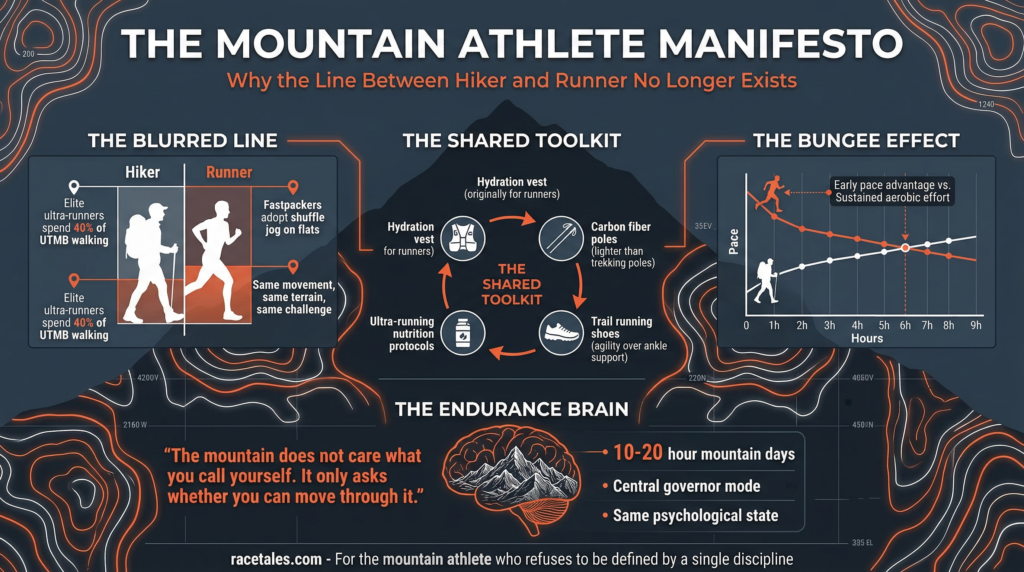
The Mountain Athlete Manifesto: Why the Line Between Hiker and Runner No Longer Exists
On the steep flanks of a mountain, labels dissolve. What remains is movement, efficiency, and the shared pursuit of going farther.
Watch the front pack of any major mountain ultra and you will notice something that surprises first-time spectators: the world’s best trail runners are walking.
Not because they are tired. Not because they have given up. They are walking because, on a 40% grade at altitude, walking is faster. It is more efficient. It is the smart play. And the athletes who understand this — who have shed the ego attached to “running” as an identity — are the ones who finish strongest.
This is the central truth that racetales.com is built on: in the mountains, the distinction between hiker and runner is largely an illusion. What matters is movement efficiency, mental durability, and the wisdom to match effort to terrain.
The Blurred Line
The convergence has been happening for years, quietly and at altitude.
Elite ultra-runners have always power-hiked the steep stuff. At the Ultra-Trail du Mont Blanc — the sport’s most prestigious 100-mile race through the Alps — athletes like Kilian Jornet and Courtney Dauwalter spend significant portions of the course moving at a brisk hike. Their heart rates are controlled, their poles are planted, and their pace on a 35% incline is nearly identical to a strong hiker who has trained specifically for mountain movement.
At the same time, the fastpacking community — hikers carrying ultralight packs across multi-day routes — has adopted the shuffle jog on flats and descents, shrinking the gap between a thru-hike and a supported ultra. A fastpacker crossing the Presidential Traverse in the White Mountains is performing the same fundamental movements, managing the same physiological demands, and making the same real-time decisions as a trail runner on the same terrain.
The movement is the same. The terrain is the same. The challenge is the same.
What differs is the label the athlete arrived with.
The Shared Toolkit
One of the clearest signs of convergence is gear. The equipment originally developed for trail running has migrated upward into hiking and mountaineering, and the direction of travel goes both ways.
A serious hiker preparing for a Colorado 14er in winter conditions will now reach for:
- A hydration vest — originally designed for runners — to distribute load across the torso and keep hands free for scrambling
- Carbon fiber running poles — lighter and more packable than traditional trekking poles — to reduce knee stress on technical descents and increase uphill propulsion
- Trail running shoes — lower stack, higher grip, faster drying than traditional hiking boots — for approaches where agility matters more than ankle support
- Nutrition protocols borrowed from ultra-running — eating every 45 minutes regardless of hunger, prioritizing carbohydrates early, treating the body as a machine that requires consistent fueling
Conversely, ultra-runners increasingly study the movement economy of elite hikers and mountaineers. The most efficient uphill walkers — guides, alpinists, thru-hikers with thousands of miles in their legs — have developed a cadence, a pole rhythm, and a weight distribution that pure runners simply do not have. Learning from them makes faster runners.
This shared kit and shared knowledge base is not a trend. It is a structural shift in how mountain athletes train, equip themselves, and define their community.
The Bungee Effect
Here is something that plays out on long mountain days with reliable consistency: the runner goes out hard, the hiker goes out steady, and somewhere around hour six they are moving at the same speed.
This is the bungee effect.
The runner’s early pace advantage gets absorbed by accumulated fatigue, fueling errors, and the physiological cost of going anaerobic on climbs. The hiker’s consistent aerobic effort — never spiking heart rate, never depleting glycogen reserves — compounds over time. By the back half of a long day, the gap has closed and sometimes reversed.
The lesson cuts both ways. Runners who incorporate long, low-intensity mountain days into their training — the kind of days a hiker calls normal — develop a deeper aerobic base and a more durable engine for the late miles of a race. Hikers who add structured aerobic running to their preparation build cardiovascular headroom that transforms their uphill pace and recovery between days.
A runner might use a three-day fastpacking trip as a high-volume training block, logging 15,000 feet of gain while keeping heart rate firmly in Zone 2. A hiker preparing for a major peak might follow a trail running training plan, replacing speed intervals with weighted hill repeats to build the specific leg strength needed for sustained climbing. The physiological outcomes — improved cardiac efficiency, favorable lipid profile shifts, enhanced mitochondrial density — are identical regardless of whether the athlete was running or walking to achieve them.
The Endurance Brain
The physical convergence is well documented. Less discussed, but equally important, is the mental one.
Moving through mountains for ten, fifteen, twenty hours produces a specific psychological state that does not distinguish between disciplines. The brain enters what researchers call a central governor mode — a protective mechanism that signals fatigue and urges the athlete to slow down or stop, often well before the body has reached true physiological failure.
Every mountain athlete, at sufficient duration and difficulty, will encounter this governor. The hiker on a solo winter traverse of the Presi Ridge in deteriorating weather faces the same internal negotiation as the ultra-runner at mile 75 of a hundred-miler. Both must learn to distinguish between the brain’s protective discomfort signals and genuine injury risk. Both must develop the emotional regulation to keep moving when everything feels wrong. Both must solve real problems — navigation, nutrition, gear failure, weather — while operating under deep fatigue.
This is the endurance brain. And it is trained the same way regardless of discipline: by spending long hours in the mountains, accumulating experience with discomfort, and building the evidence base that tells the central governor I have been here before and I came through.
A hiker who completes a 22-mile day in the White Mountains with 8,000 feet of gain has trained the endurance brain as effectively as a runner completing the same route at faster pace. The duration and the difficulty are what matter. The label does not.
Mutual Training, Mutual Respect
The most sophisticated mountain athletes understand that cross-training across disciplines is not a compromise — it is an accelerant.
Long-distance hiking provides the aerobic volume and time-on-feet that makes runners more durable in the late stages of a race. It builds the specific connective tissue resilience — tendons, ligaments, the small stabilizing muscles of the ankle and knee — that pure road running does not develop. A runner who spends July fastpacking the Long Trail in Vermont will arrive at their September race with legs that have seen terrain, a gut that has learned to process food while moving for nine hours, and a brain that has solved weather problems and navigation challenges under fatigue.
High-intensity trail running, in turn, gives hikers a cardiovascular ceiling they cannot build through hiking alone. Short, steep uphill running intervals — even 20 minutes twice a week — elevate VO2 max, improve lactate clearance, and translate directly into a faster, more sustainable hiking pace on long mountain days.
The communities benefit from each other. The gear travels in both directions. The training methods cross-pollinate. And on the mountain itself — on the actual terrain where all of this matters — a strong hiker and a strong runner are often indistinguishable.
What This Means for You
Whether you arrived at this site as a trail runner eyeing your first hundred-miler, a hiker planning a Presidential Traverse, or someone who has never quite decided what to call yourself in the mountains — you are in the right place.
racetales.com exists for the mountain athlete who refuses to be defined by a single discipline. For the runner who power-hikes the steep stuff without apology. For the hiker who jogs the flats without needing a race bib to justify it. For anyone who has stood on a summit after a long, hard day and understood, in their body, what efficiency actually feels like.
The mountain does not care what you call yourself. It only asks whether you can move through it.
We are here to help you move better, go farther, and understand what your body and mind are capable of when the terrain gets serious.